“Open bar” sounds like one of the simplest items on a wedding quotation. Until you start comparing what’s actually included.
Two caterers may both offer an open bar, yet be quoting very different services: different durations, different spirits and cocktails, different bar setups and, sometimes, different additional service costs.
And if you’re planning a destination wedding in Italy, there’s another important distinction to understand. An open bar doesn’t usually mean cocktails are served throughout the entire celebration.
Aperitivo, dinner and the party each have their own drinks service, and the open bar typically belongs to the last of these.
Understanding how it works before comparing quotations will help you choose the right service for your guests, avoid unexpected extras and decide where your bar budget is actually worth spending.
What Does “Open Bar” Actually Mean at a Wedding in Italy?
If you’re used to weddings where cocktails are available throughout the celebration, the drinks service at a wedding in Italy may work a little differently.
Typically, each part of the wedding reception in Italy has its own drinks selection.
During the aperitivo, guests are usually offered wine, prosecco and lighter cocktails such as Aperol Spritz or Hugo Spritz. At dinner, wine becomes the main focus, while the full open bar usually begins with the party, when cocktails and spirits take over.
This doesn’t mean you can’t have cocktails earlier. You absolutely can. But they’re not normally included as a continuous open bar from aperitivo through dinner, so if that’s what you have in mind, it needs to be discussed and quoted separately from the beginning.
There’s also a cultural reason behind this structure. In Italy, drinks during dinner are traditionally considered in relation to the food. Wines are selected to complement the menu rather than compete with it, while cocktails naturally become more prominent once dinner ends and the celebration moves into the party.
So when you see open bar on a catering proposal, don’t automatically read it as unlimited cocktails throughout the wedding.
The first thing to check is when the open bar actually starts, because that’s where understanding what you’re being offered begins.
What’s Actually Included, and for How Long?
Not all open bar packages are structured in the same way, which is why comparing the price alone can be misleading.
Most caterers we work with offer packages based on a set number of hours, usually two or three, with a price per person that may vary according to the number of guests. Others work with a flat fee.
Then there’s what you can actually order at the bar.
Open bar packages are often divided into different levels, primarily based on the brands of spirits included and the range of cocktails available. A basic package may cover standard spirits and classic cocktails, while higher tiers introduce premium brands and drinks that require more ingredients or preparation. Espresso Martinis, for example, aren’t always included in entry-level packages, and tequila often appears only from an intermediate level upwards.
Trying to customize a basic package by adding individual premium spirits or cocktails isn’t necessarily the most economical solution. In our experience, once several upgrades are involved, moving to the next package often makes more sense.
Duration deserves just as much attention. If your party lasts longer than the hours included, you’ll always need to extend the open bar, but that may not be the only additional cost. Depending on the caterer’s policy, extending the event can also trigger additional wedding costs, including extra service hours for their staff.
And an extra hour affects more than the bar. The DJ or band, sound and lighting team and sometimes your coordination team may all need to stay longer too. That’s why we define the final party duration well before the wedding rather than extending it spontaneously on the night. This way, you know exactly what an extra hour of celebration really costs before deciding how long you want the party to last.
What About Cocktails During Dinner?
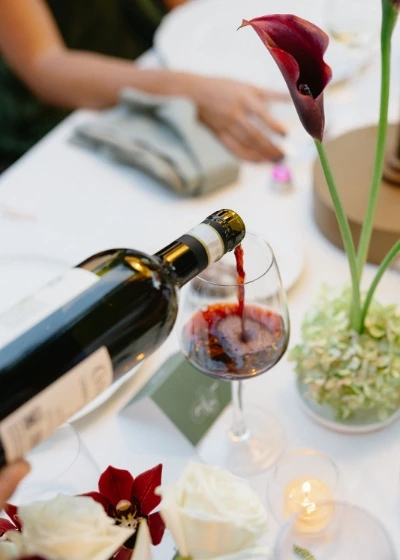 | 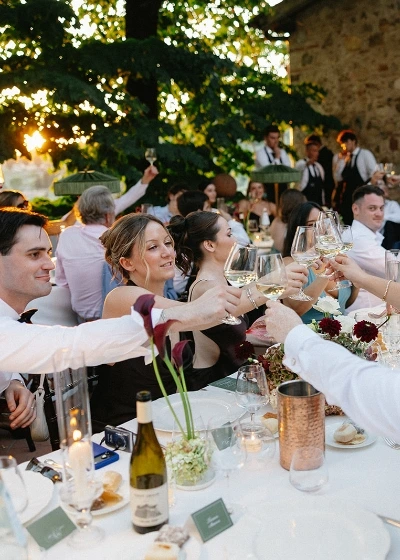 |
One of the most common questions we receive from international couples is whether cocktails can also be served during dinner. The answer is absolutely yes, but they’re not normally part of the standard dinner service at a wedding in Italy.
Traditionally, wine takes center stage during dinner. This reflects a very Italian approach to food and drinks: the two are considered together. Wines are selected to complement the menu and accompany the different courses, rather than having stronger cocktail flavors competing with the food.
This is why, when you receive a catering quotation, dinner will typically include wine and water, while the full cocktail service begins later, when the party starts.
Of course, this doesn’t mean you have to follow that format. If Espresso Martinis, Old Fashioneds or your favorite cocktails are part of how you imagine the evening, they can absolutely be served during dinner. You could also choose to have the full open bar available earlier.
The important thing is to plan for it from the beginning. Cocktail service during dinner is an addition to the standard drinks service, not something you should assume is included in the open bar quoted for the party. It may require additional bartenders, ingredients and service time, all of which will affect the quotation.
In other words, the traditional Italian flow is a starting point, not a restriction. You can shape the drinks service around the experience you want, you just need to make that choice before the catering service is defined.
Who Provides the Open Bar?
Depending on your catering setup, the open bar may be provided by the same company handling the food or by a separate bar catering company.
When the food caterer also offers a good bar service, keeping everything with the same supplier is usually the most cost-effective option. The bartenders are dedicated professionals, whether part of the catering company or brought in specifically for the event, so choosing a separate bar company doesn’t necessarily mean better cocktails or faster service.
A specialized bar caterer becomes useful when there’s a specific reason for it. This is often the case when a venue works with an in-house caterer whose food is excellent, but whose overall event and bar service is less developed, or when the couple wants a particular bar setup that the food caterer can’t provide.
Some caterers also require exclusivity and don’t allow an external company to provide the drinks, so this is something that should always be checked before considering a separate supplier.
Ultimately, the choice is less about who makes the better cocktail and more about finding the right balance between service, cost and setup for that particular wedding.
Where You Put the Bar Matters as Much as How It Looks
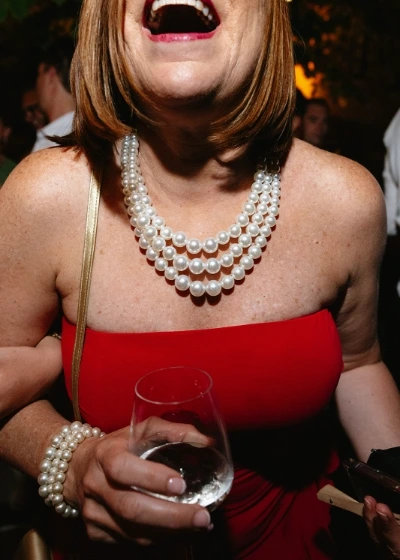 |  |
The bar isn’t just another element to style. Its position can have a surprisingly big impact on the energy of your party.
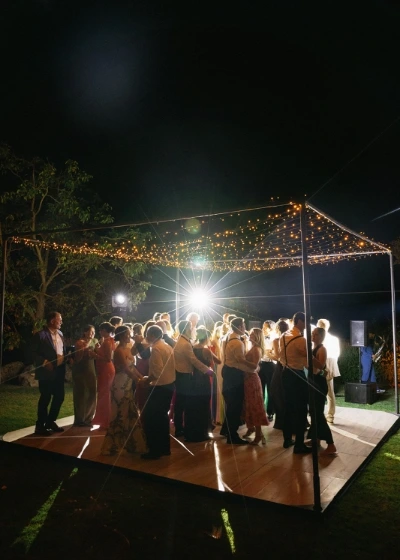
Whenever the venue layout allows it, we try to keep the bar close to the dance floor. The reason is simple: guests naturally move back and forth for drinks throughout the party. If the bar is nearby, they remain part of the action. If they need to walk into another room or across the venue every time they want a drink, the dance floor can empty much more easily.
We’ve seen this happen firsthand. At one wedding, the party started outdoors and later moved inside, but the couple chose to have only one bar rather than setting up a second one. Once everyone moved indoors, guests still had to go outside for drinks, and we could see the dance floor losing people each time.
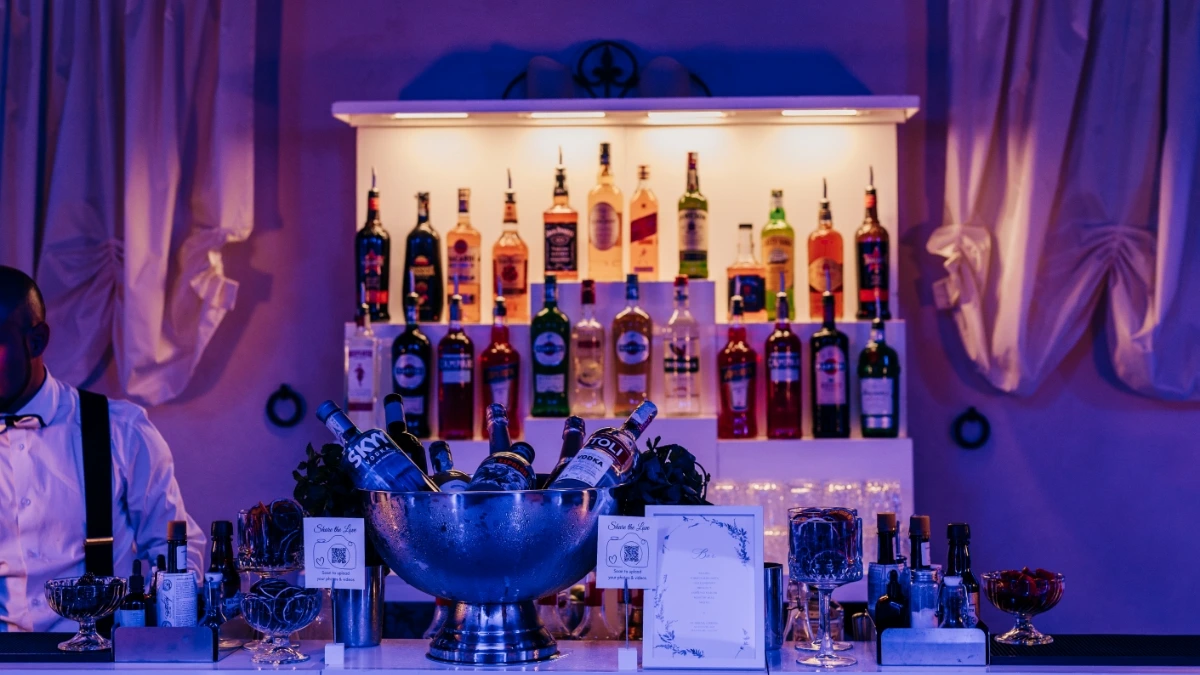
Of course, the bar should also feel visually connected to the wedding. Depending on the caterer, the standard setup might be a simple table with linen or an actual bar counter. Specialized bar companies usually offer a wider choice of counters, and when there are different options available, we help couples select the one that works best with the overall wedding design. Flowers, signage and a coordinated cocktail menu can then make even a simple setup feel intentional.
Signature cocktails are another easy way to add a personal touch. Giving a favorite drink a meaningful name and including it on the cocktail menu costs very little, or nothing at all, but it’s one of those small details guests tend to enjoy.
When planning the bar, our priority is therefore simple: first make sure it works for the party, then make sure it looks like it belongs there.
Can You Have a Cash Bar at a Wedding in Italy?
We’ve occasionally had couples ask whether guests can pay for their own drinks during the party, usually as a way to reduce the open bar budget.
Technically, cash bars can exist in Italy, but they’re not normally offered by the wedding caterers we work with. For the weddings we plan, the bar service is agreed and paid for in advance by the couple, rather than individual guests paying for their drinks during the event.
If you’re looking to reduce the cost, there are better ways to do it. Choosing a more basic open bar package can make a meaningful difference without having much impact on the guest experience, unless, of course, your guests are particularly selective about spirits and brands.
Another option is to shorten the open bar, although during the party this effectively means shortening the party itself. As we’ve seen above, the two usually go hand in hand.
The key is to build the bar service you want into the budget from the beginning, rather than expecting guests to cover part of the cost on the wedding day.
How to Choose the Right Open Bar for Your Wedding
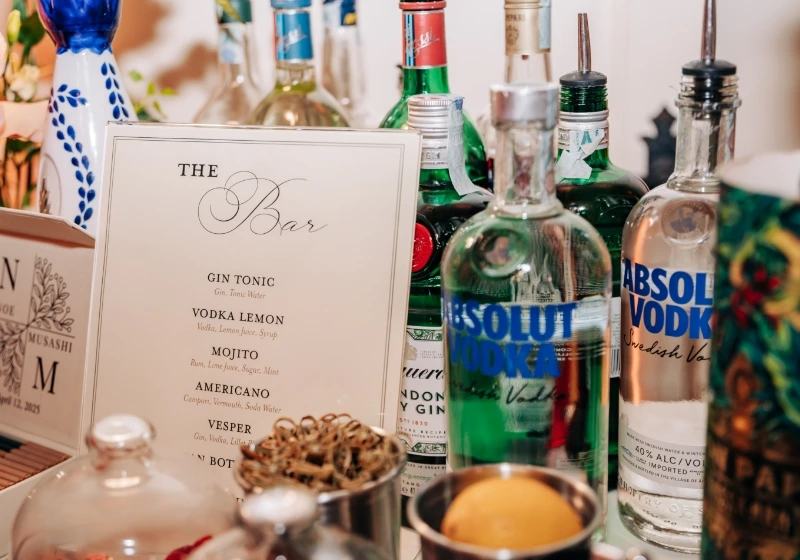
The most expensive open bar package isn’t necessarily the right one for your wedding. What matters most is understanding how much your guests actually care about what goes into their drinks.
If most of them simply order a Gin & Tonic without asking for a specific gin, for example, they may never notice whether you’re serving a standard or premium brand. In that case, upgrading to a top-tier package may add considerably more to the cost than it does to the guest experience.
This is why most of our couples choose either a basic or intermediate package, with the intermediate option often providing a good balance between variety, quality and cost.
Specific drinking preferences, however, can change the decision completely. If you know your friends will be ordering tequila all night, or that Espresso Martinis are going to be a must, check which package includes them. Sometimes one or two important drinks are enough to make upgrading more practical, and more economical, than trying to add them individually to a basic package.
The same principle applies to premium spirits. If your guests know their gins, whiskies or tequilas and regularly order particular brands, investing in a higher-level package may genuinely improve their experience. If they don’t, that part of your budget may be better spent elsewhere.
The right open bar isn’t the one with the longest cocktail list or the most premium bottles. It’s the one that matches the way your guests actually drink.
Ultimately, an open bar may look like a relatively simple line in your wedding budget, but the choices behind it, when it starts, how long it lasts, what’s included and even where it’s positioned, can affect much more than the drinks themselves.
When you’re planning a wedding in Italy, understanding how the drinks service flows from aperitif to dinner and into the party allows you to make those choices with much more clarity. Define the experience you want first, then build the bar service around it.